
The Moment You Notice It
You pull into the driveway after work, press the remote, and — nothing. Or maybe the opener hums for a second and quits. Or the door starts up, jerks, and reverses itself like it hit an invisible wall. Whatever the exact moment looks like, it's rarely convenient, and it's usually accompanied by that sinking feeling that this might be an expensive fix.
The good news: most garage doors that won't open fail for one of a handful of reasons, and a technician checks them in a specific order—cheapest and most obvious first, then working toward the parts that actually require tools and replacement hardware.
What the Door Is Telling You
Before any screwdriver comes out, the symptom itself narrows things down:
- Complete silence when you press the remote or wall button—no light, no hum, nothing.
- A hum or click from the opener, but the door doesn't move at all.
- The door starts to open, then stops or reverses partway through the cycle.
- The door is physically heavy or won't budge even when you try to lift it by hand with the opener disconnected.
Each of these points a technician in a slightly different direction, which is why the diagnostic order matters.
What a Technician Checks, In Order
1. Power and Controls
This sounds basic, but it's first for a reason—it's the fastest thing to rule out. Is the opener plugged in? Has a breaker tripped, especially after one of Holmes County's afternoon storms? Is the remote's battery dead, or has the wall switch lost connection? During hurricane season, brief power blips are common, and sometimes the opener's circuit board needs a manual reset after an outage before it'll respond again.
2. Safety Sensors
If the opener hums but the door won't move, the photo-eye sensors near the bottom of the tracks are next. These two small sensors send a beam across the opening, and if anything blocks it—or if humidity has fogged or dirt has coated the lenses—the opener refuses to close the door as a safety measure. Florida's humidity and afternoon downpours mean these lenses can collect moisture or grime more often than in drier climates. A quick wipe-down and realignment check solves this more often than homeowners expect.
3. Springs
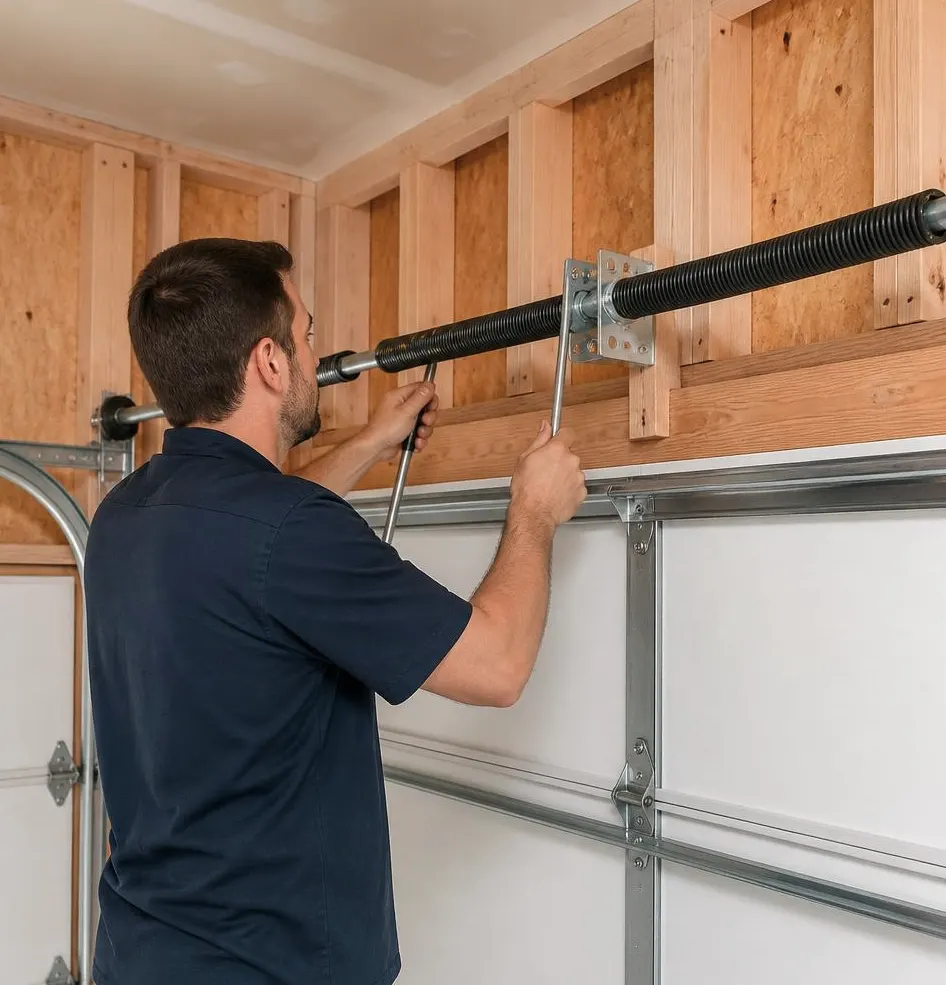
If the door won't move even when you disconnect the opener and try lifting it by hand, the springs are almost always the issue. A garage door is heavier than it looks, and the torsion or extension springs do the real work of lifting it—the opener just guides the motion. When a spring breaks, you'll often hear a loud bang (sometimes mistaken for a gunshot or a car backfiring) at some point before the failure, and afterward the door feels like dead weight.
Springs are rated for a certain number of open-close cycles, and heat and humidity accelerate wear by promoting rust on the coils, especially on older doors that haven't had regular lubrication. This is also the point where a technician stops and brings in the right tools—springs are under extreme tension and not a DIY repair.
4. Cables and Rollers
Next come the cables that work alongside the springs, and the rollers that guide the door along its tracks. A frayed or snapped cable will often cause the door to hang crooked or stop halfway. Rollers that have rusted or seized from moisture exposure can bind in the track and stall the opener's motor, which sometimes gets mistaken for a dead opener when it's really just friction.
5. Track Alignment
If the door looks like it's leaning, or one side is higher than the other, the tracks have likely shifted out of alignment. This can happen gradually from loose mounting hardware, or suddenly if the door was bumped by a vehicle. Wind-load stress during storm season can also rattle fasteners loose over time, so a track check is a routine part of storm-season inspections here.
6. Opener Motor and Gears
Last on the list, because it's the least common actual cause despite being everyone's first guess, is the opener itself. Stripped internal gears, a worn drive belt or chain, or a failing motor can all prevent the door from moving even when everything else checks out. Openers typically last a decade or more, but constant heat and humidity exposure in an unconditioned garage can shorten that lifespan.
When to Call Precision Garage Door of Westville
If you've checked the power and the sensors and the door still won't budge, it's time to call in a technician rather than keep testing the remote. A heavy door that won't lift by hand is almost certainly a spring problem, and that's not something to force—attempting it yourself risks injury and further damage to the door and opener. Our Garage Door Spring Repair service handles this safely, with the correct springs rated for your door's weight and cycle needs.
If the door is visibly crooked, grinding, or stuck off its tracks, that's a job for our Off Track Door Repair service, where we realign the tracks, replace worn rollers, and make sure everything moves smoothly again before the next storm front rolls through.
If your garage door in Westville FL won't open, don't force it by hand and don't keep hammering the remote button. Call Precision Garage Door of Westville and we'll get it diagnosed and fixed, often the same day.